Steak on a Pellet Grill: Reverse Searing Done Right
How I reverse sear steak on a pellet grill: smoke at 225, pull at 115, then sear as hard as your grill allows. Honest answers on 400 vs 450, real sear capability, and cast iron.
 By Oleg Galeev, cooking on pellet grills since 2020, runs the OleGrill YouTube channel
Short answer
Smoke the steak at 225°F until it reads 110-115°F internal for medium-rare, rest it while the grill climbs to its hottest setting, then sear hard: over direct flame if your grill offers it, in preheated cast iron if it does not. You get an even rosy interior and a crust that actually crunches.
Live prices. Affiliate links: we may earn a commission at no extra cost to you. How this works.
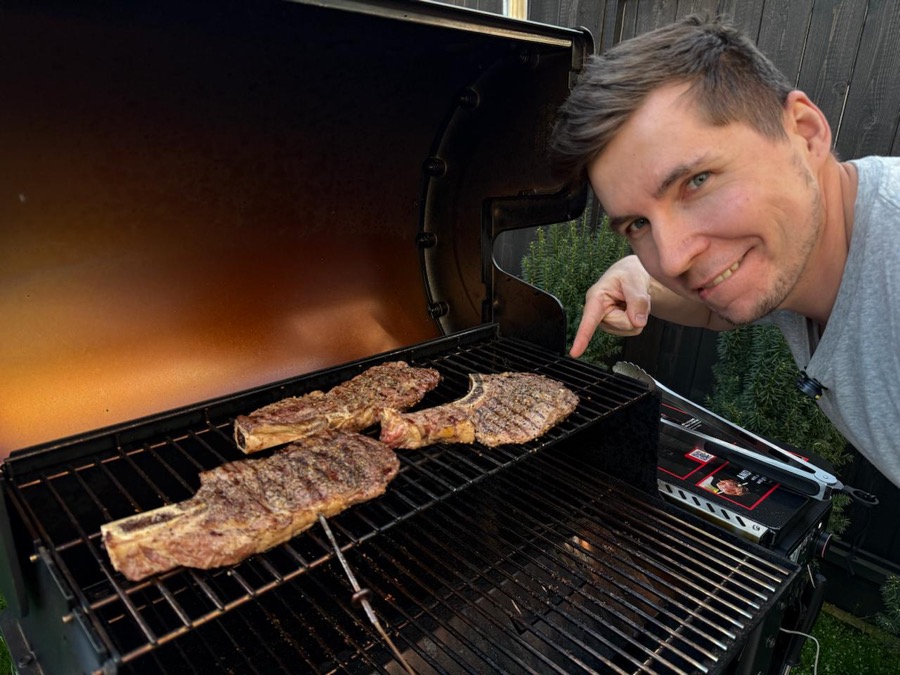
The first steak I ever cooked on a pellet grill came off looking like it had been steamed in a brown paper bag. Smoke flavor, sure. Crust, none. That was 2020, on my first grill, and I have spent six years and a lot of ribeyes figuring out exactly where pellet grills fail at steak and how to make them stop. The short version: the smoker half of the job is easy, the sear is where the machines separate, and the reverse sear is the method that plays to what a pellet grill does best.
Should you grill steak at 400 or 450?
Neither number matters much for a thick steak. For steaks under an inch, run 450°F: the shorter cook loses less moisture and builds more crust before the center overshoots. Anything 1.25 inches or thicker deserves a reverse sear instead, where the sear-stage temperature matters far more than either of those settings.
The 400-versus-450 question really only applies to hot-and-fast cooking on thinner cuts. A skirt steak, a flat iron, a thin sirloin: those I treat the same way I treat patties in my burger guide, lid closed, hottest convection setting, flipped once, done in minutes. At 400°F the cook stretches out and the surface spends too long in the sweat zone, that wet gray stage where juice beads on top faster than the air can dry it. At 450°F the surface dries and browns sooner, so the center is still where you want it when the outside finally looks right.
On a thick ribeye or strip, both settings fail the same way. By the time convection air at 450°F builds real color, you have a half-inch gray band under the crust and a bullseye of medium-rare in the middle. That is the whole argument for the reverse sear: separate the interior cook from the crust cook and run each at the temperature it actually needs.
One more honest note on why technique matters more than it did a few years ago. Steak has gotten expensive enough that a botched cook stings.
Do you reverse sear at 225 or 250?
Both work, and I use both. I run 225°F when I want maximum smoke and a perfectly even rosy interior; 250°F when dinner needs to happen sooner. On a 1.5-inch ribeye the gap is roughly 15 to 20 minutes of smoke time, not a different steak on the plate.
The low phase of a reverse sear is doing two jobs at once. It brings the interior up slowly and evenly, so there is almost no gray band, and it dries the surface, which sets up the sear. Slower is gentler on both counts. At 225°F the temperature gradient inside the meat stays shallow, and the steak picks up noticeably more smoke simply because it sits in the smoke longer. This is the same logic that governs brisket, just compressed from twelve hours into one.
At 250°F you trade a little of that evenness and smoke for speed, and on a weeknight that trade is fine. Where I draw the line is 275°F and up. Past that, the outer layers start cooking meaningfully faster than the core and you are drifting back toward the gradient problem the reverse sear exists to solve.
Here is how the clock actually plays out on a 1.5-inch ribeye, from my cooks:
| Method | Low phase | Rest | Sear | Rough total |
|---|---|---|---|---|
| Reverse sear at 225°F | 45-60 min to 110-115°F internal | 5-10 min while grill heats | 60-90 sec per side | 60-75 min |
| Reverse sear at 250°F | 35-45 min to 110-115°F internal | 5-10 min while grill heats | 60-90 sec per side | 50-60 min |
| Traditional sear-first at 450°F | none | none | 2-3 min per side, then 5-10 min indirect | 12-18 min |
The traditional column is there because it is honest: sear-first is four times faster. It also gives you a wider gray band and a fraction of the smoke. Pick your priority.
Can a pellet grill actually sear a steak?
Most cannot, and I will not pretend otherwise. A convection-only pellet grill tops out with the lid closed and gives you color, not crust. A real sear needs flame or metal directly under the meat, which is exactly what DirectFlame and slide-plate designs add and what everything else fakes with cast iron.
Browning is the Maillard reaction, and it needs two things at the meat surface: serious heat and dryness. Circulating hot air, which is all a standard pellet grill has, delivers neither fast enough. The air dries the surface eventually, but it transfers heat so gently that by the time a crust forms, the interior has blown past medium. That is the paper-bag steak from my first season.
The fix is radiant or conducted heat, and the industry has finally built it in. Here is how the field actually breaks down:
| Grill type | How it sears | Crust quality | Examples |
|---|---|---|---|
| Direct-flame mode | Opens the fire pot to the grates; flame hits the meat | Genuine hard crust, grill marks and all | Weber Searwood DirectFlame, Camp Chef slide-and-grill plate |
| High-temp convection only | Hot circulating air, lid closed | Color and light browning, no crunch | Most Traeger, Z Grills, entry Pit Boss models |
| Cast iron assist | Preheated skillet or griddle conducts heat | Very good, close to stovetop | Any pellet grill, added cost and cleanup |
This is where the Weber Searwood XL earns its spot at the top of our pellet grill rankings. Slide the panel, open the flame, and it stops being a smoker and becomes a real grill for the last three minutes of the cook. I finish steaks over that open flame every week, and if you want one machine that handles both halves of a reverse sear without accessories, check the current price on the Searwood XL. Owners of convection-only grills are not stuck, though. Skip ahead to the cast iron section.
What temperature do you pull a reverse-seared steak?
Pull at 110-115°F internal for medium-rare. The rest and the sear together add another 15 to 20 degrees, which lands you at 130-135°F on the plate. Guessing by feel fails at these margins; a probe thermometer is the entire trick of the reverse sear.
The number that matters is the pull temperature at the end of the smoke phase, because everything after it is momentum. The steak keeps climbing while it rests, then the sear pushes heat back into the outer half inch. Pull at your final target and the sear will carry you a full doneness level past it.
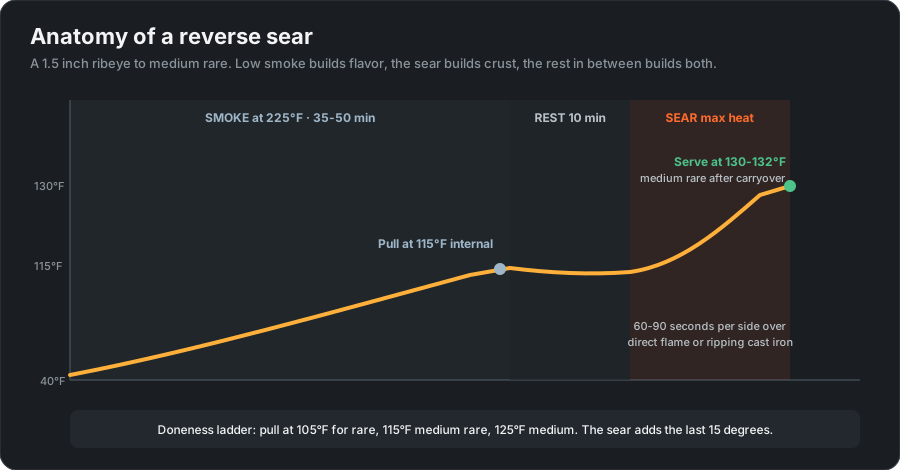
Here is my full pull chart, doneness by doneness:
| Doneness | Pull from smoke phase | Final temp after sear and rest |
|---|---|---|
| Rare | 105-110°F | 120-125°F |
| Medium-rare | 110-115°F | 130-135°F |
| Medium | 120-125°F | 140-145°F |
| Medium-well | 130-135°F | 150-155°F |
| Well done | 140-145°F | 160°F+ |
The honest fine print: USDA lists 145°F with a three-minute rest as the safe minimum for whole-muscle beef on its safe temperature chart. A medium-rare steak sits below that line. Intact steaks carry surface bacteria, not interior bacteria, and the sear hammers the surface, which is why most of us accept the trade. But that is your call to make with open eyes, and if you are cooking for anyone immunocompromised, pregnant, very young or very old, cook to 145°F and choose a cut with enough fat to stay pleasant there.
One probe habit worth stealing: probe horizontally through the side of the steak into the center, not down through the top. On a steak under two inches thick, a top-down probe reads the gradient, not the core, and it will lie to you by five degrees.
Cast iron on a pellet grill: worth it?
Worth it on any pellet grill without a direct-flame mode, which is still most of them. A cast iron skillet or griddle preheated through the entire smoke phase hits the steak with conducted heat the grates cannot deliver. If your grill already sears over open flame, save the money and the cleanup.
The method is simple and it works because of thermal mass. Put the skillet on the grate when you start the smoke phase, off to one side, and leave it there the whole time. By the time the steak hits 115°F internal, that iron has been soaking heat for an hour. Pull the steak, crank the grill to max, give the pan ten more minutes, then a thin film of high smoke-point oil, then the steak: about a minute per side, pressing gently so the whole face makes contact. The crust rivals a stovetop sear because it effectively is one, just outdoors with the smoke already in the meat.
Three honest caveats from my bench. First, cleanup is real: rendered ribeye fat plus a 500°F pan means smoke, spatter, and a skillet to scrub while everyone else eats. Second, the pan blocks airflow across part of the grate, so on smaller barrels keep it to one side rather than dead center over the fire pot. Third, weight: a loaded 12-inch skillet plus a steak is an awkward, heavy lift over a hot grill, and welding gloves are not optional.
There is also a middle path I use on windy days: sear the flat side of a two-sided cast iron griddle instead of a skillet. More surface, no walls to trap steam, easier to wipe down. Whichever you pick, this is the difference between a convection grill that browns a steak and one that finishes it properly. It is the cheapest sear upgrade in barbecue, and the process behind that judgment is laid out in the same protocol we use for every cooker on this site.
Should I dry brine a steak before reverse searing?
Yes. Salt it generously and leave it uncovered on a rack in the fridge, from 45 minutes to overnight. The salt seasons deeper and the fridge air dries the surface, which speeds up the sear. A drier surface browns faster, and faster browning means less overcooking underneath.
Do I flip the steak during the smoke phase?
Once, around the middle of the low phase, is plenty. Convection heat surrounds the meat, so flipping matters far less than it does over coals. I flip mainly to even out the side facing the fire pot, which runs slightly hotter on most barrels.
Can I reverse sear a steak thinner than an inch?
I would not. A thin steak races through the low phase in minutes, picks up little smoke, and overshoots during the sear. Cook thin steaks hot and fast at your grill's max setting instead, flipped once. Save the reverse sear for 1.25 inches and up.
How long should a reverse-seared steak rest after the sear?
Barely at all, and that is one of the method's quiet perks. The long, gentle low phase means the juices are already settled; the sear only heats the outer surface. Three to five minutes gets you a hot, dry crust and no puddle on the board.
Do I sear with the lid open or closed?
Open, whenever you are searing over direct flame or in cast iron. Closing the lid turns the sear back into a convection roast and steams the crust you are trying to build. Lid open, meat over the heat, tongs in hand, and stay with it; a direct-flame sear moves in seconds, not minutes.