Brisket on a Pellet Grill: Real Times, Temps, and the Probe Test That Decides It
How long brisket takes on a pellet grill, what temperature to run, paper vs foil, and why 200°F internal can still be tough. Times, tables, and the grill I trust overnight.
 By Oleg Galeev, cooking on pellet grills since 2020, runs the OleGrill YouTube channel
Short answer
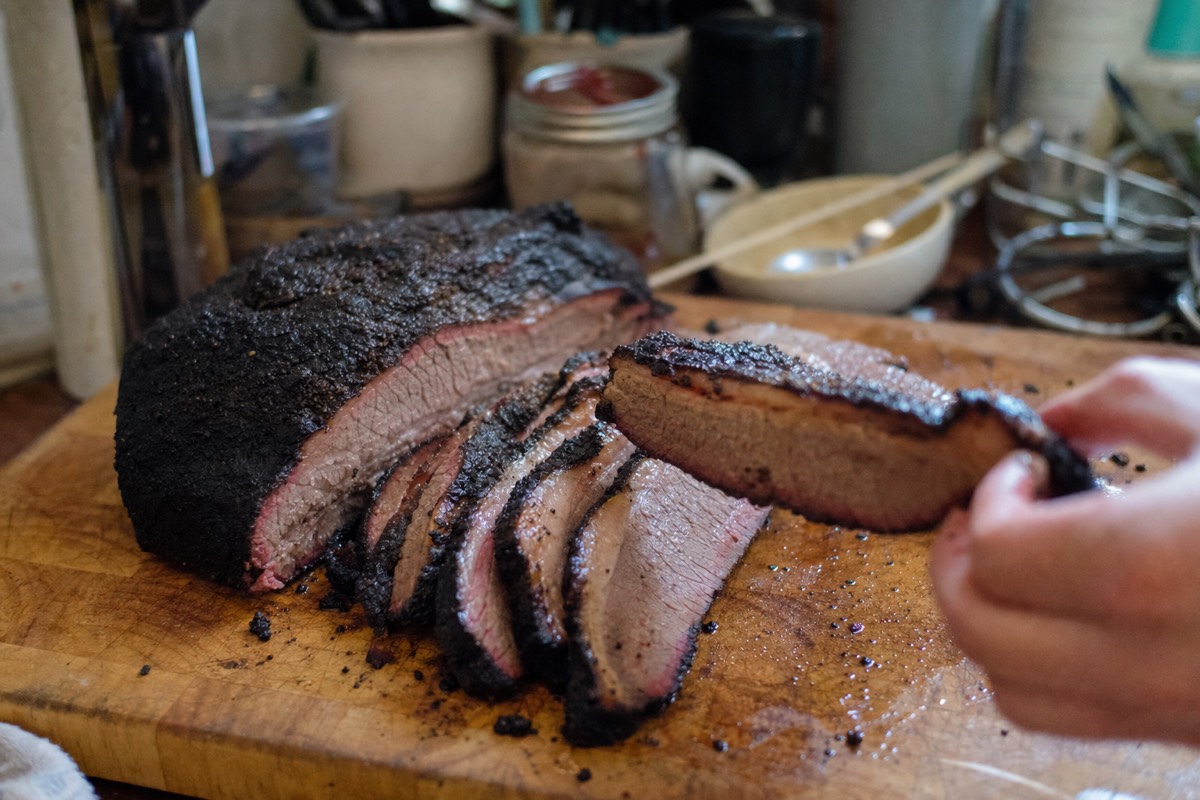
Smoke brisket at 225°F on a pellet grill and plan 30 to 90 minutes per pound, so a 12 pound packer can run 6 to 18 hours. Wrap in butcher paper at the stall, then pull when a probe slides in like soft butter around 200 to 205°F internal. Feel decides doneness, not the clock.
Live prices. Affiliate links: we may earn a commission at no extra cost to you. How this works.
The hopper hum at 2 a.m. is a sound I know too well. Folding chair, cold coffee, a 13 pound packer stuck at 163°F for the third straight hour. Then it broke through the stall, the bark set, and by lunch I was slicing through a smoke ring you could see from across the yard. That is brisket on a pellet grill: long stretches of nothing, one short window where everything matters. After six years of these cooks for the OleGrill channel, here is what actually holds up.
How long does brisket take on a pellet grill?
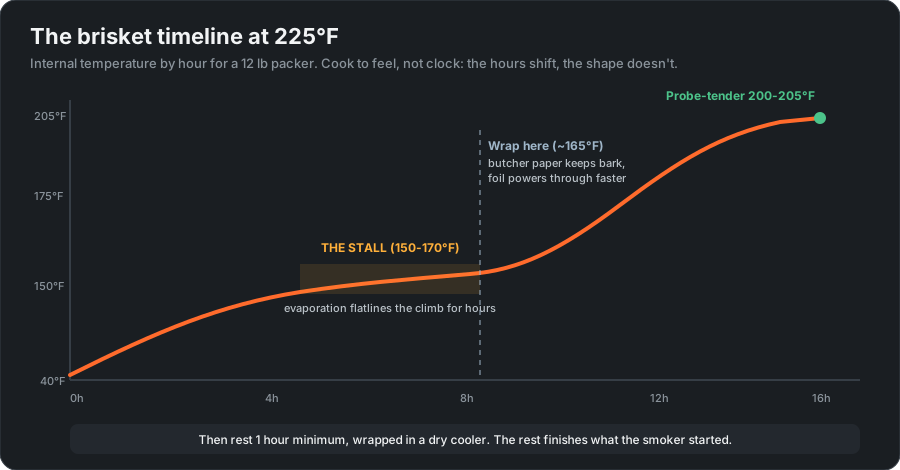
At 225°F, plan on 30 to 90 minutes per pound, so a 12 pound packer can land anywhere between 6 and 18 hours. That spread is real, not lazy hedging. Brisket is finished when a probe slides into the flat like soft butter, usually around 200 to 205°F internal, never when the clock says so.
The wide range annoys people, and I get it. But two briskets of identical weight can finish five hours apart depending on thickness, fat, grade, and how long the stall drags. My logs on the same grill, same temp, same rub show 12 pound packers finishing anywhere from 11 to 17 hours. So plan for the long end. An early brisket holds happily for hours wrapped in towels inside a dry cooler. A late one ruins dinner.
Budget like this at the three temps pellet grills run best. These are planning windows, not promises; the probe finishes the job.
| Grill temp | Time per pound | 12 lb packer, realistic window | What you get |
|---|---|---|---|
| 225°F | 30 to 90 min | 6 to 18 hours, budget 12+ | Deepest smoke flavor, longest stall |
| 250°F | 30 to 60 min | 6 to 12 hours | My usual compromise, minor smoke tradeoff |
| 275°F | 30 to 45 min | 6 to 9 hours | Hot and fast, wrap early to protect bark |
One more habit that saves cooks: start the night before. A brisket that goes on at 10 p.m. at 225°F gives you the whole next morning as buffer, and the rest just makes it better.
What temperature should you smoke brisket at?
Run 225°F when smoke flavor and bark are the priority, 250°F for the best balance of time and results, and 275°F when you need it done today. Beef is technically safe to eat at 145°F, but brisket collagen does not render into gelatin until the meat pushes past 195°F, which is why low and slow wins.
That safety number trips up a lot of first-timers. The USDA safe temperature chart lists 145°F as the minimum for whole cuts of beef, and that figure is about killing pathogens, nothing more. A brisket pulled at 145°F is safe and nearly inedible, a slab of tight collagen and unrendered fat. The connective tissue only breaks down with hours spent well above that mark, and the transformation does not finish until the interior grinds through the high 190s and low 200s.
Pellet grills make the temperature decision easy because the controller does the fire management. Set 225°F on a decent unit and it holds within a few degrees for a day straight, something charcoal cooks pay for in sleep. My default has become 225°F overnight, then a bump to 250°F in the morning if the stall drags past breakfast. Whatever you pick, resist chasing the grill thermometer; ambient swings average out over a cook this long. The number that matters lives inside the flat.
Which pellet grill is best for brisket?
The best brisket grill is the one that holds 225°F dead steady for 18 hours without a hopper refill. For dedicated brisket cooks, my pick is the recteq Flagship 1600: its 40 pound hopper is the largest I have run, and it turns overnight packers into a set-it-and-sleep cook.
Most pellet grills can smoke a decent brisket. Fewer can do it while you sleep. A standard 18 pound hopper burning a pound or more per hour gets uncomfortably close to empty on a long winter cook, and a hopper that runs dry at 4 a.m. is how flameouts and 150°F wake-up calls happen. I have topped off hoppers by headlamp more times than I want to admit.
That is why the Flagship 1600 earned the brisket slot in my rotation. The 40 pound hopper swallows two full bags, which means a 17 hour packer finishes with pellets to spare, no alarms, no headlamp. Temperature swing on mine stays inside a handful of degrees at 225°F, and the chamber fits two packers side by side. It sits at number two on this site overall behind the Weber Searwood XL, but for long unattended smokes it is the one I load, and you can check the current price to see where it sits this week. The full field, including the Searwood and the budget picks, is ranked on the pellet grills page, and the overnight hold test behind these calls is documented in how we test.
Should you wrap brisket in butcher paper or foil?
Butcher paper is the best all-round wrap for pellet grill brisket. It breathes just enough to keep most of the bark intact while still pushing the meat through the stall. Foil is faster and wetter but steams bark soft, and going naked builds the darkest crust at the cost of hours and a drier flat.
The wrap exists to beat the stall, that maddening plateau in the 150s and 160s where evaporative cooling holds the meat hostage. Wrapping cuts evaporation, so the internal temp starts climbing again. What you wrap with decides what you trade away.
| Wrap | Bark | Speed through the stall | Moisture |
|---|---|---|---|
| Butcher paper | Dark and mostly intact, slight softening | Faster than naked, slower than foil | Good, renders fat stays close |
| Foil (Texas crutch) | Soft, edges go pot roast | Fastest, braises right through | Highest, collects a pan of jus |
| No wrap | Thickest, darkest crust | Slowest, stall can run 4+ hours | Riskiest for the flat drying out |
My routine: run naked until the bark is set, usually 165 to 170°F internal, then wrap in two overlapped sheets of peach butcher paper and ride it home. Foil still has its place. When I am behind schedule, or smoking a lean flat that needs every drop of protection, the crutch saves the cook, the same call that comes up in the foil stage on ribs. Just know the bark pays for it.
The stall logic is not unique to brisket, by the way. The exact same wrap decision, on a shorter clock and with more forgiveness, is the heart of a good pulled pork cook, which is where I would send any first-time low and slow cook before they gamble a packer.
Should you buy a flat, a point, or a whole packer?
Buy the whole packer if your grill fits it. The flat and point together, 10 to 16 pounds untrimmed, cost the least per pound and cook the most forgivingly, since the fatty point bastes and shields the lean flat. A flat alone is smaller and easier to dry out. The point alone makes the best burnt ends.
Brisket comes off the steer's chest, a pair of hard-worked pectoral muscles that support most of the animal's weight, which is exactly why it is packed with the collagen that demands all those hours. The two muscles are very different meat. The flat is lean, uniform, and slices clean. The point is marbled, ragged, and juicy, the part people fight over.
Prices moved hard this year, so here is the current landscape by cut.
| Cut | Typical weight | What you pay right now | Best for |
|---|---|---|---|
| Whole packer | 10 to 16 lb | $4.57 to $5.33/lb on grocery features | Overnight cooks, crowds, burnt ends plus slices |
| Flat only | 4 to 6 lb | $7.93/lb wholesale for Choice, more at the case | Clean slices, smaller grills, weeknight-adjacent cooks |
| Point only | 5 to 7 lb | Rarely sold separately, usually comes inside the packer | Burnt ends, chopped brisket sandwiches |
At these prices a ruined packer stings more than it used to, which is one more argument for the probe test below and for practicing on cheaper cuts first.
Why is my brisket at 200 degrees but still tough?
Because internal temperature is a rough gauge, not a finish line. At 200°F some briskets are done and some still have unrendered collagen holding them tight. Probe the thickest part of the flat in several spots. If you feel resistance, keep cooking and recheck every 30 to 45 minutes, even past 205°F.
This is the question I get most on the channel, usually from someone standing over a brisket at 201°F that slices like a tire. The thermometer told you where the meat is, not whether it is ready. Collagen conversion depends on temperature and time together. A brisket that raced to 200°F has spent fewer hours in the rendering zone than one that crawled there, so the connective tissue lags behind the number.
A turkey is the opposite kind of cook: you pull it the moment the breast hits its number, and waiting longer only costs you. Brisket inverts that logic completely. The number gets you into the neighborhood. Feel closes the deal. Slide an instant-read probe into the flat at a few points: done brisket accepts it like warm butter, with a soft give and no push-back. Any drag or squeak means more time, and I have had stubborn packers refuse to probe tender until 208°F.
Two other culprits show up when tough brisket lands in my inbox. First, slicing with the grain instead of across it, which makes even perfect brisket chew like rope. Second, skipping the rest. An hour minimum, wrapped in a cooler, lets the juices redistribute and the texture settle. Four hours held that way is even better.
What is the 3-2-1 rule for brisket, and the 4-2-10 rule?
The 3-2-1 method is actually a ribs schedule, 3 hours of smoke, 2 wrapped, 1 unwrapped, and it gets misapplied to brisket, which is far too big for a 6 hour clock. The 4-2-10 version circulating for brisket means roughly 4 hours of smoke, 2 hours wrapped to finish, then a hold of up to 10 hours. The long rest is the genuinely good idea in there. Treat both as loose frameworks and let the probe make the final call.
What is the poor man's brisket?
A smoked chuck roast. Chuck comes from the shoulder, carries similar marbling and connective tissue, and takes the same 225°F treatment, but a 3 to 4 pound roast finishes in 6 to 8 hours instead of an overnight shift. It shreds more than it slices. It is my standing recommendation for a first low and slow cook, since a mistake costs a fraction of what a packer runs at current prices.
Is brisket the hardest meat to smoke?
On traditional smokers, probably yes: you are managing a live fire for 12+ hours while judging doneness by feel. A pellet grill deletes the fire management half of that problem, so what remains is patience and the probe test. I still rank it above ribs, pork shoulder, and poultry in difficulty, because the cut punishes impatience and the cook is too long to redo the same day.
Do you smoke brisket fat side up or down on a pellet grill?
Fat side down. Pellet grills push heat from a fire pot below the deflector, so the bottom of the meat takes the most direct energy, and the fat cap becomes a shield for the lean flat. The old fat-side-up basting theory does not hold anyway; melting fat mostly rolls off rather than soaking in. If your grill runs hot near the stack, point the thicker end that way too.
Can you leave a pellet grill running overnight for brisket?
Yes, and overnight cooks are half the reason brisket cooks buy pellet grills. Do it sensibly: start with a clean fire pot, vacuum old ash, keep the grill clear of walls, and load enough pellets to outlast the cook, since a hopper that runs empty at 3 a.m. means a flameout. A big bin like the Flagship 1600's 40 pounds exists for this, and a wireless probe with an alarm buys you real sleep.