Pulled Pork on a Pellet Grill: Pork Butt Times, Temps, and When to Wrap
How I smoke pulled pork on a pellet grill: pork butt time per pound at 225, 250, and 275, the 6-2-2 rule, when to wrap, and honest yield math from raw weight to sandwiches.
 By Oleg Galeev, cooking on pellet grills since 2020, runs the OleGrill YouTube channel
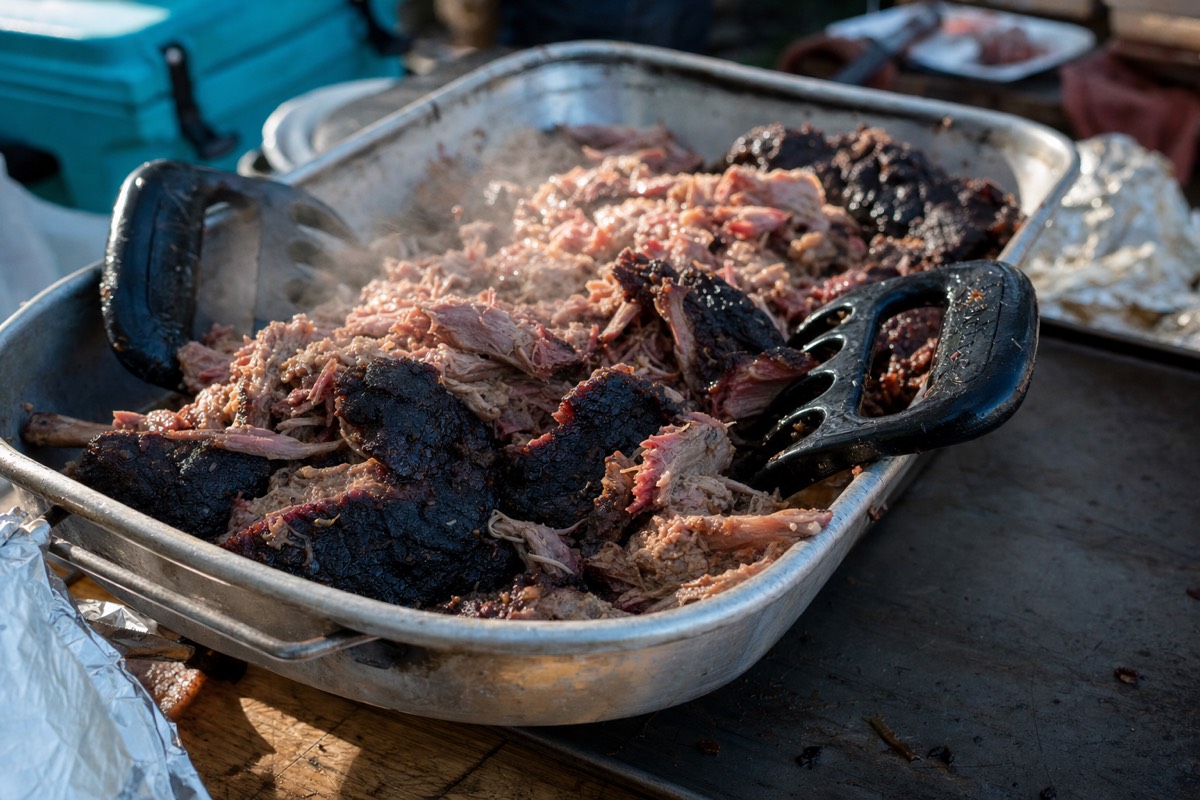
Short answer
Smoke a bone-in pork butt at 250°F on a pellet grill, about 1.25 to 1.5 hours per pound, wrap in butcher paper when the stall hits around 160°F, and pull it off at 195-205°F internal when a probe slides in with no resistance. Rest at least an hour. Expect roughly half the raw weight as finished pulled pork.
Live prices. Affiliate links: we may earn a commission at no extra cost to you. How this works.
The blade bone tells you everything. When a pork butt is truly done, you pinch that flat bone and it slides out clean, wet, with nothing clinging to it, and the whole muscle underneath sighs apart. I have pulled that bone out of more butts than I can count since 2020, and I have also yanked on it at hour eight, felt it fight back, and known I had three more hours ahead of me. Pulled pork is the most forgiving cook you can run on a pellet grill, but the internet has buried it under rules with numbers in them: 6-2-2, 3-2-1, 225 versus 250. Some of those rules are useful. One of them belongs to a different cut entirely. Here is what actually happens on the grill.
What is the best cooking method for a pork shoulder?
Low and slow smoking is the best method for a pork shoulder headed for pulled pork: 250°F on a pellet grill until the internal temperature reaches 195-205°F and a probe slides in like it is going into warm butter. Braising works for carnitas, but only a long smoke builds bark while fully rendering the collagen.
First, the naming mess, because the store label matters. The whole pork shoulder is two cuts. The upper half is the Boston butt, which despite the name comes from the shoulder, not the rear of the pig. The lower half is the picnic shoulder. When a recipe says pork butt, Boston butt, or pork shoulder for pulled pork, it almost always means the upper cut. Buy that one. The butt is a blocky, evenly shaped muscle group threaded with fat, so it cooks evenly and shreds into moist strands. The picnic is leaner, tapered, and often comes with skin that blocks smoke.
Now the temperature question people trip on. The USDA safe temperature for whole pork cuts is 145°F with a three minute rest, and that number is real: a butt at 145°F is perfectly safe to eat. It is also nearly inedible as pulled pork. At 145°F the collagen that webs through the shoulder has barely started converting to gelatin, so the meat is safe, tough, and impossible to shred. You keep cooking another 50 to 60 degrees past safe, not for safety, but for texture. Somewhere between 195 and 205°F the connective tissue finishes melting and the muscle gives up. That gap between food-safe and fork-tender is the entire reason this cook takes ten hours instead of two, and it is why no oven shortcut at high heat produces the same result. The pellet grill's job is to hold a boring, steady temperature for half a day while smoke does the interesting work.
How long does a pork butt take per pound?
Plan on 1.5 to 2 hours per pound at 225°F, 1.25 to 1.5 hours per pound at 250°F, and roughly an hour per pound at 275°F for a bone-in butt. An 8 pound butt at 250°F usually lands between 10 and 12 hours, and the probe, not the clock, calls the finish.
| Pit temperature | Time per pound (bone-in) | Typical 8 lb butt total |
|---|---|---|
| 225°F | 1.5 to 2 hours | 12 to 16 hours |
| 250°F | 1.25 to 1.5 hours | 10 to 12 hours |
| 275°F | about 1 hour | 8 to 9 hours |
Those ranges are wide on purpose. Two butts from the same case, same weight, same pit temp, can finish two hours apart. The variable that wrecks most first-timers is the stall: somewhere between 150 and 170°F internal, the temperature stops climbing and sits there, sometimes for three or four hours. Nothing is wrong with your grill. The surface of the meat is sweating, and that evaporation cools the butt as fast as the pit heats it, exactly the way sweat cools you. The same wall shows up in a brisket cook, just usually longer and meaner there.
What the stall means for planning: never schedule a butt to finish right at dinner time. I start an 8 pounder at 6 a.m. for a 6 p.m. meal, and when it finishes early, which it usually does, it rides wrapped in a dry cooler. A held butt stays hot for hours and gets better, not worse. A rushed butt pulled at 185°F because guests arrived turns into sliced pork and regret. Give the cook a buffer of at least two hours and let the resting cooler absorb the slack.
Is it better to smoke pulled pork at 225 or 250?
250°F is the better default on a pellet grill. A pork butt carries enough internal fat that it does not need the 225°F treatment, and the hotter pit shortens the stall and finishes hours sooner with no real moisture penalty. I save 225°F for overnight starts when I want extra hours in smoke.
I ran this comparison enough times on my own grills to stop debating it. At 225°F you buy more time in smoke, and on a stick burner that matters. On a pellet grill, which burns clean and puts out a lighter smoke profile anyway, the extra hours at 225 add surprisingly little flavor while stretching the stall painfully. At 250°F the bark sets earlier, the collagen renders just as completely, and side by side the finished meat is nearly indistinguishable. The one pattern I like: start at 225°F at 11 p.m., sleep, then bump to 250°F at breakfast. You get the overnight convenience and the daytime speed.
What matters more than the setpoint is whether your grill actually holds it for twelve unattended hours, which is a controller and hopper question, not a technique question. Our pellet grill rankings sort exactly that, and for pulled pork duty specifically the Pit Boss Pro Series 850 is the one I point friends to first: honest temperature control, enough hopper for an overnight butt, and a price that leaves money for a decent thermometer, so check the current price before assuming you need to spend twice as much. Whatever you run, put a leave-in probe in the meat and stop opening the lid. Every peek costs you pit recovery time, and the butt does not need supervision. It needs patience and pellets.
When do you wrap a pork butt?
Wrap when the internal temperature stalls between 150 and 170°F, typically around 160°F, and only after the bark has set enough that rubbing it with a finger does not smear it. Foil powers through the stall fastest, butcher paper keeps more bark, and skipping the wrap costs hours but builds the thickest crust.
| Approach | When to do it | Bark result | Effect on time | The trade |
|---|---|---|---|---|
| No wrap | never wrap, ride it out | thickest, darkest crust | longest cook, full stall | max smoke and bark, driest surface |
| Foil (Texas crutch) | at the stall, 150-165°F internal | soft, steamed | fastest, can cut hours | bark softens, but foil catches juices for mixing back in |
| Butcher paper | 160-170°F internal, bark set | mostly preserved | middle ground | breathes enough to keep crust, stall runs longer than foil |
The bark test matters more than the number. Wrap too early and you steam off the crust you spent six hours building; the rub smears like wet sand and never recovers. Wait until the surface is set, mahogany, and dry to the touch. For pulled pork I usually reach for foil rather than paper, which is the opposite of my brisket call. Here is why: pulled pork gets shredded and mixed, so a slightly softened bark disappears into the pile, and the cup of rendered juices trapped in the foil is liquid gold to pour back over the shredded meat. Bark purists should run paper or no wrap at all and simply budget the extra hours. There is no wrong answer on this table, only different trades, and the honest advice is to pick based on your schedule. Tight timeline, foil. Lazy Saturday with nowhere to be, no wrap, and enjoy the crunchiest exterior of the three.
What is the 6-2-2 rule for pork?
The 6-2-2 rule is schedule shorthand for pork butt: roughly 6 hours of unwrapped smoke, 2 hours wrapped to push through the stall, then a 2 hour rest. It fits a 6 to 8 pound butt at 250 to 275°F reasonably well, but internal temperature always overrules the clock.
I treat 6-2-2 as a planning tool, not a cooking instruction. Where it works: a mid-size butt at a 250°F-plus pit temp will often hit the stall right around that six hour mark with the bark set, which makes hour six a sensible wrap point, and two wrapped hours at those temps can genuinely carry it to probe-tender. The two hour rest at the end is the most underrated part of the whole formula. A butt that rests wrapped in a cooler for two hours redistributes its juices, finishes rendering with carryover heat, and shreds noticeably better than one pulled apart twenty minutes off the grill.
Where 6-2-2 falls apart: run a 10 pound butt at 225°F and the schedule is fantasy. You will still be mid-stall at hour eight, and wrapping on a timer instead of on bark condition gives you pale, mushy crust. The rule also says nothing about the finish line, and that is its real flaw, because the finish line is 195-205°F internal with a probe that slides in everywhere without resistance, including the money muscle on the opposite side from the bone. So use 6-2-2 to decide when to start the cook and when to tell people dinner is. Then run the actual cook on a thermometer and your fingertips. When the clock and the probe disagree, the probe is telling the truth.
What is the 3-2-1 method for pulled pork (and does it belong to ribs instead)?
3-2-1 belongs to spare ribs, not pulled pork: 3 hours of smoke, 2 hours wrapped, 1 hour back on the grill sauced. Six total hours will not finish a pork butt at 225°F. The name gets borrowed because both cooks involve a wrap phase, but the timings do not transfer.
This mix-up shows up constantly in search results and comment sections, so let me kill it plainly. The 3-2-1 method was built for spare ribs at 225°F, where a full rack is maybe two inches thick and six hours is actually enough, arguably too much, to take them past tender. A pork butt is a different animal: a dense, eight pound block that needs to climb 60 degrees past food-safe before it will shred. Pull a butt at the six hour mark of a 225°F cook and you will find it sitting somewhere in the 160s, mid-stall, sliceable with effort and completely unshreddable. I have watched someone try to serve that at a tailgate. Everyone chewed politely.
The confusion is understandable because the shape of the two cooks rhymes: smoke bare, wrap through the tough middle stretch, finish and rest. If you want a rib-style formula for butts, 6-2-2 above is the closest honest analog, and even that one needs a thermometer to back it up. The deeper lesson applies to every timed method on the internet, including mine: times are estimates, temperatures are facts, and tenderness is the verdict. Learn what probe-tender feels like once and you will never be hostage to a countdown again, on ribs, butts, or anything else with connective tissue.
How much pulled pork will a butt actually yield?
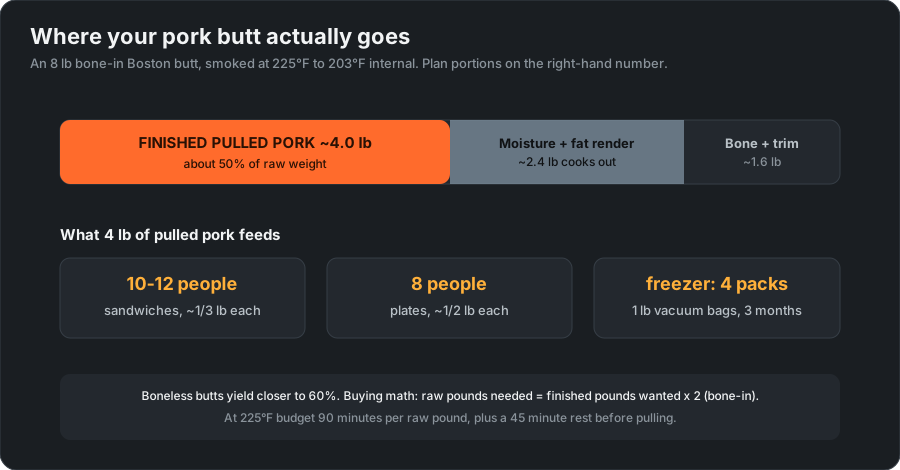
Plan on about 50% of raw weight as finished pulled pork from a bone-in butt and about 60% from boneless. An 8 pound bone-in butt gives you roughly 4 pounds of pulled meat, which builds about a dozen sandwiches at a third of a pound each.
The shrink surprises people the first time. Water evaporates through a twelve hour cook, fat renders out into the drip bucket, and the bone and its cap of connective tissue go in the trash. Half your raw purchase disappearing is normal, not a sign you overcooked it. Here is the buying math I actually use:
| Raw weight | Pulled yield, bone-in (~50%) | Pulled yield, boneless (~60%) | Sandwiches at 1/3 lb |
|---|---|---|---|
| 4 lb | ~2.0 lb | ~2.4 lb | 6 to 7 |
| 6 lb | ~3.0 lb | ~3.6 lb | 9 to 11 |
| 8 lb | ~4.0 lb | ~4.8 lb | 12 to 14 |
| 10 lb | ~5.0 lb | ~6.0 lb | 15 to 18 |
Given those swings, my rule is to buy bone-in when it is featured and stash a second butt in the freezer. Bone-in costs less per raw pound, cooks a touch more evenly in my experience, and hands you the clean-bone doneness test for free. Boneless yields more per raw pound but often arrives netted from two flopping pieces, which cooks less predictably. Either way, cook more than you think you need. Leftover pulled pork freezes flat in vacuum bags and reheats better than almost any barbecue, and how we weigh, log, and cook every test butt is laid out in how we test.
Should the fat cap go up or down on a pellet grill?
Down. Pellet grills heat from below through a deflector plate, so the fat cap shields the meat from the hottest surface. Trim it to about a quarter inch first. On offset smokers the debate is real, but on a pellet grill the heat source settles it.
How long should pulled pork rest before shredding?
A minimum of 45 minutes, and one to two hours wrapped in a dry cooler is better. The internal temperature drifts down slowly, juices redistribute, and the meat shreds without scorching your hands. Held wrapped and insulated, a butt stays at safe serving heat for several hours.
Can I pull pork at 195°F instead of 205°F?
Yes, if it probes tender. The 195-205°F window is a range because every butt renders differently. Test with the probe in several spots: when it slides in everywhere with no resistance and the bone wiggles free, it is done at whatever number the thermometer shows.
Is bone-in or boneless pork butt better for pulled pork?
I buy bone-in. It is usually cheaper per pound, holds its shape better during a long smoke, and the bone gives you a built-in doneness test. Boneless yields more finished meat per raw pound, around 60% versus 50%, so it wins when you are feeding a crowd on a deadline.
Do I need to inject a pork butt before smoking?
No. A butt has enough internal fat to stay moist without help, which is why it is the best first low and slow cook. Injection is insurance for competition boxes and very lean supermarket pork. Get the temp, wrap, and rest right before you bother with a syringe.