Traeger Ironwood vs Timberline: Where the Extra Money Actually Goes
I have cooked on both the Ironwood and Timberline lines side by side. Verified specs, honest value math, and why the Ironwood wins for almost everyone.
 By Oleg Galeev, cooking on pellet grills since 2020, runs the OleGrill YouTube channel

Short answer
Buy the Ironwood. It carries the same WiFIRE app, the same Super Smoke mode, the same verified 500°F ceiling, and on the XL the same 10-year warranty as the Timberline, for a lot less money. The Timberline only earns its price if budget truly does not matter and you want the induction burner and full stainless build.
Live prices. Affiliate links: we may earn a commission at no extra cost to you. How this works.
Two pork butts went on at the same set point one Saturday in May, one in my Ironwood XL, one in a Timberline XL parked next to it. Same bag of hickory pellets split between the hoppers, same rub, lids down by 7 a.m. Ten hours later I pulled both, stood there with my thermometer, and could not tell you which grill cooked which butt. That afternoon is this whole comparison in miniature. It is one of the matchups behind the best wood pellet grills rankings on this site.
Here is what the verified data on file actually shows for all four current models. A dash means the number has not been verified yet, and I would rather show you a gap than a guess.
| Spec | Ironwood | Ironwood XL | Timberline | Timberline XL |
|---|---|---|---|---|
| Price | $1,700 | - | - | - |
| Cooking area (sq in) | - | 924 | 880 | 1,320 |
| Hopper (lb) | - | - | 22 | 22 |
| Max temp | 500°F | 500°F | 500°F | 500°F |
| WiFi (WiFIRE) | Yes | Yes | Yes | Yes |
| Direct-flame sear | No | No | No | No |
| Warranty | - | 10 years | 10 years | 10 years |
Read those dashes honestly. The standard Ironwood's cooking area, hopper size, and warranty term are not in my verified file yet, and neither is a current price for any model except the $1,700 standard Ironwood. Timberline pricing moves around with promotions, so check the live listing before you commit. Everything I argue below leans only on the numbers that are verified.
Pull temps still follow the USDA safe minimum internal temperatures for poultry, pork, and ground beef, no matter which hopper you bought.
Warranty language is what Traeger's warranty page actually publishes, not a forum guess.
What actually separates the Traeger Timberline from the Ironwood?
The Timberline is Traeger's halo grill: an induction side burner, full stainless touches, and a showpiece build. The Ironwood is the working grill underneath it, with the same WiFIRE app, the same Super Smoke mode, and the same verified 500°F ceiling. The cooking hardware that changes your food overlaps almost completely.
I have cooked on all four of these, and the honest summary is that the Timberline is the Ironwood wearing a tuxedo. The controller behaves the same. The app is the same app. Super Smoke does the same thing on both when you drop below smoke-mode temps.
| Feature | Ironwood line | Timberline line |
|---|---|---|
| WiFIRE app control | Yes | Yes |
| Super Smoke mode | Yes | Yes |
| Induction side burner | No | Yes |
| Full stainless halo build | No | Yes |
| Verified max temp | 500°F | 500°F |
| Direct-flame searing | No | No |
The induction burner is genuinely nice. I have seared scallops on it while a brisket rested inside the barrel, and finishing a sauce next to the grill instead of running to the kitchen is a real pleasure. But notice what is not on the Timberline's side of that table: more heat. Both lines cap at the same verified 500°F, and neither one direct-sears. The most expensive Traeger you can buy hits steaks with exactly the same top end as the Ironwood.
Which holds temperature better?
Neither, in any way you would taste. All four models run Traeger's D2 drivetrain and WiFIRE controller with an identical verified 500°F ceiling, and in my cooks they hold a set point the same way. The Timberline's insulated double-wall body shrugs off wind a bit better, which matters in January, not in July.
Every pellet grill works the same way at heart: an auger meters pellets into a firepot, a fan feeds the fire, a controller does the thinking. Ironwood and Timberline share that thinking. Same controller family, same drivetrain, same app issuing the same commands.
I do not have side-by-side probe logs in the verified file yet, so I will not print hold numbers I cannot back. What I can tell you from a season of cooking on both: I set 225°F, I walk away, and both grills are where I left them when I come back. The one honest difference is the Timberline's double-wall stainless body. On a windy 30-degree day it recovers from a lid open a little quicker and sips fewer pellets doing it. If you smoke through northern winters, that insulation is the single best functional argument for the Timberline. If your grill lives in Texas or Georgia, you are paying for a coat you will rarely wear.
Which is built to last?
On verified paper they tie. The Ironwood XL, Timberline, and Timberline XL all carry the same 10-year warranty, the longest Traeger offers. The Timberline's stainless-heavy construction looks and feels a class up, but Traeger itself backs both lines for the same decade.
This is the part of the halo pitch that falls apart under the warranty table. If Traeger believed the Timberline's build bought you meaningfully more service life, you would expect it to stand behind that grill longer. It does not. Ten years on the Ironwood XL, ten on both Timberlines. The standard Ironwood's warranty term is one of those unverified gaps in my file, so I will not claim it matches, but the XL's is on record.
What the Timberline's stainless actually buys you is cosmetic endurance. It will look newer, longer, especially uncovered near a coast. My Ironwood XL's powder-coated body has taken two years of deck weather with nothing worse than scuffs. Under a cover, I would not bet on a lifespan difference you could measure. If sheer build quality per dollar is your priority, that fight has stronger contenders outside Traeger entirely, which is exactly what our recteq vs Traeger comparison gets into.
What does the value math say?
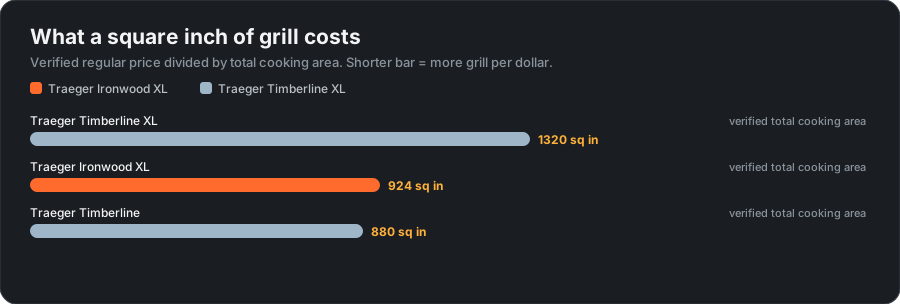
The only verified price on file is the standard Ironwood at $1,700. Verified areas say the Timberline XL offers 396 more square inches than the Ironwood XL, about 43 percent more room, while the standard Timberline actually gives you 44 fewer square inches than the Ironwood XL. Same temps, same warranty, so Timberline money mostly buys the burner and the steel.
I cannot print a clean price-per-square-inch for every model, because most of the prices are not in the verified file, and I will not fake them. But the spread the verified numbers do allow is telling.
| Verified math | Result |
|---|---|
| Timberline XL area vs Ironwood XL | 1,320 vs 924 sq in: +396 sq in, about 43% more |
| Timberline (standard) area vs Ironwood XL | 880 vs 924 sq in: 44 sq in less |
| Warranty, all verified models | 10 years, identical |
| Max temp, all four models | 500°F, identical |
| Hopper, both Timberlines | 22 lb, identical to each other |
| Only verified price on file | Ironwood, $1,700 |
Sit with that second row for a second. The standard Timberline, the premium grill, cooks on less rack space than the Ironwood XL while matching it on temperature ceiling, WiFi, and warranty length. Whatever the standard Timberline costs on the day you read this, it will be more than an Ironwood XL, and the verified spec sheet cannot explain why. The XL Timberline at least answers with real capacity, 1,320 square inches is a genuine whole-packer-plus-everything-else surface. But you are paying flagship money for it.
Which one should a first-timer buy?
The Ironwood, and it is not close. A first-timer's results improve with practice, good pellets, and a grill that holds temperature, all of which the Ironwood delivers identically to the Timberline. Nobody's first brisket ever failed for lack of an induction side burner.
If you are new to pellet cooking, the honest hierarchy goes like this. First, learn the craft: our pellet grill guides will do more for your food than any spec sheet. Second, buy the grill whose features you will actually use in year one, which is the WiFIRE app, Super Smoke, and a dependable controller. The Ironwood has all three. Third, keep money in reserve for pellets, a good instant-read thermometer, and a cover.
I would even push a nervous first-timer to look one shelf down before looking up. The gap between a budget pellet grill and an Ironwood is real but survivable, and our Traeger vs Pit Boss comparison walks through exactly what the cheaper route costs you. And for what it is worth, our overall top pick for most buyers is not a Traeger at all: the Weber Searwood XL sits outside this family fight entirely, you can check the current price and see how it stacks up in our Weber vs Traeger comparison. But between these two Traegers, the Ironwood is the first-timer's answer every time.
Who should actually spend Timberline money?
Someone building an outdoor kitchen who will genuinely cook on that induction burner weekly, smokes year-round in a cold climate where the insulated body earns its keep, and can absorb the price without flinching. That is a real person. It is just not most people.
I want to be fair to the Timberline, because it is not a bad grill. It is a beautiful one. The stainless work is the nicest Traeger makes, the burner turns the cart into a legitimate cooking station, and the insulated barrel is a real advantage anywhere winter means business. If you host a lot, cook outside twelve months a year, and the difference in price genuinely does not register in your budget, the Timberline will not disappoint you.
But be honest about which of those describes you. In my cooking, the food coming off the Timberline XL and the Ironwood XL is indistinguishable, because the parts that touch flavor are the same parts. The Timberline is a luxury trim level. Luxury trims are lovely. They are also, by definition, the thing you skip when you want the value.
Verdict: which Traeger should you buy?
The Ironwood wins for almost everyone. It delivers the meaningful 80 percent of the Timberline, WiFIRE, Super Smoke, the same 500°F ceiling, and on the XL the same 10-year warranty, at a price the Timberline cannot justify on any verified spec. Buy the Timberline only when budget genuinely does not matter.
My recommendation is the Ironwood XL specifically: 924 verified square inches, more than the standard Timberline offers, with the full 10-year warranty behind it. The standard Ironwood at a verified $1,700 is the value play if its size fits your household, with the honest caveat that its area, hopper, and warranty numbers are still unverified in my file.
The Timberline is the right buy for exactly one profile: the cold-climate outdoor-kitchen builder for whom price is noise. If that is you, get the XL and enjoy the 1,320 square inches. Everyone else keeps several hundred dollars and gives up nothing they will ever taste.
Is the Traeger Timberline better than the Ironwood?
It is more premium, not better at cooking. Both lines share the WiFIRE app, Super Smoke mode, and a verified 500°F maximum, and the verified warranty terms are an identical 10 years. The Timberline adds an induction side burner and full stainless construction, which improve the experience around the grill, not the food inside it.
Do the Ironwood and Timberline use the same app and controller?
Yes. Both run Traeger's D2 drivetrain with WiFIRE control through the same Traeger app, and both include Super Smoke mode. Set points, timers, and probe monitoring work identically across the two lines, which is a big part of why the cooking results come out so close.
How long do these Traegers last?
Traeger backs the Ironwood XL, Timberline, and Timberline XL with the same verified 10-year warranty, its longest coverage. The standard Ironwood's warranty term is not in my verified data yet. Kept under a cover and cleaned regularly, I would expect either line to serve well past the coverage window.
Can the Ironwood or Timberline sear a steak?
Neither offers direct-flame searing, and both cap at a verified 500°F. You can get a respectable crust at max temp on a preheated grate, but if hard searing is a priority, no current Traeger in either line does it the way a direct-flame pellet grill can.
Is the Timberline XL worth it over the Ironwood XL?
Only if you need the space and want the luxuries. The Timberline XL's verified 1,320 sq in beats the Ironwood XL's 924 by about 43 percent, and it adds the induction burner and insulated stainless body. Temperature ceiling and warranty are identical, so the food itself will not change.