Smoked Chicken on a Pellet Grill: Times, Temps, and the Skin Problem
How I smoke chicken on a pellet grill: real times and temps by cut, whole bird vs spatchcock vs pieces, the USDA 165°F rule, and three fixes for rubbery skin.
 By Oleg Galeev, cooking on pellet grills since 2020, runs the OleGrill YouTube channel
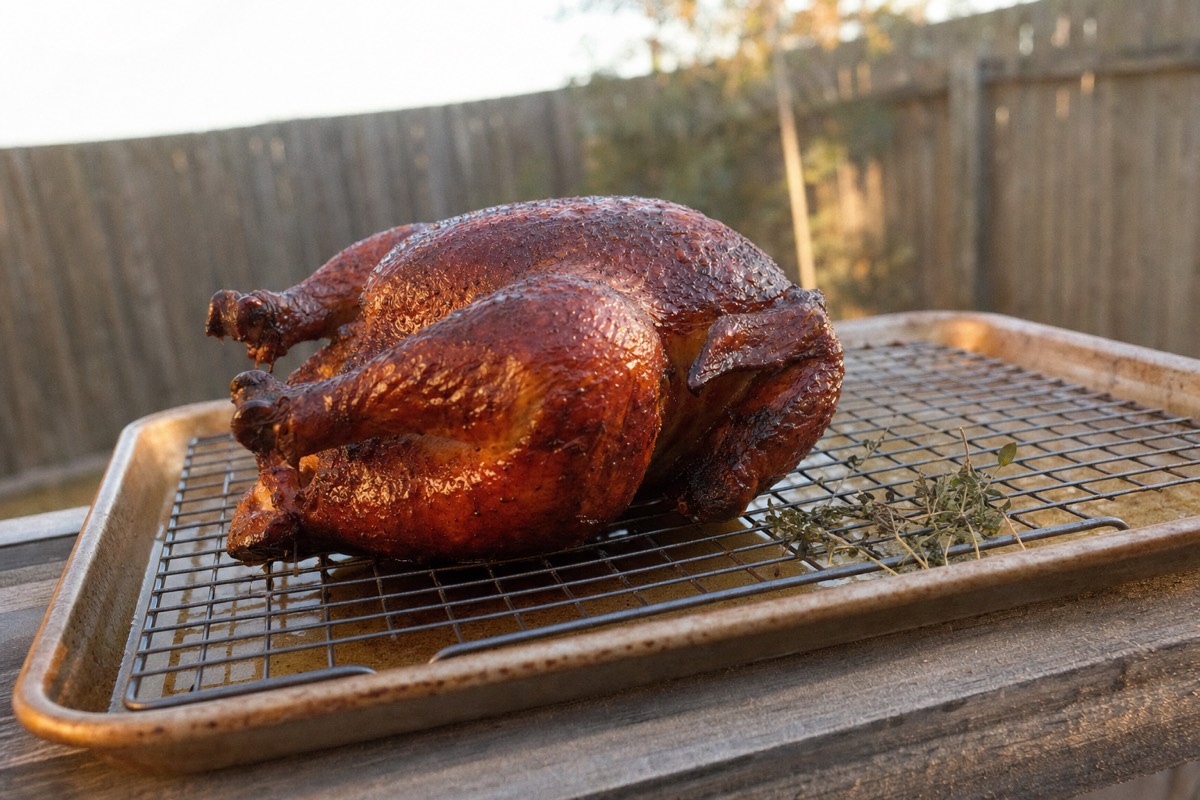
Short answer
Skip the classic 225°F smoke for chicken. Run the pellet grill at 300 to 375°F, spatchcock the bird so it cooks flat and even, and pull it when the thickest part of the breast reads 165°F. You get smoke flavor, juicy meat, and skin you can actually bite through.
Live prices. Affiliate links: we may earn a commission at no extra cost to you. How this works.
The first whole chicken I smoked on a pellet grill came off the grates looking like a magazine cover and eating like a wetsuit. Mahogany color, gorgeous smoke ring, and skin so rubbery my kids peeled it off in one sheet and left it on the plate. That was 2020. Since then I have run birds through every pellet grill on my deck for the OleGrill channel, and chicken is the cook where I changed my method the most. Brisket forgives you. Chicken does not.
Here is everything that actually matters: the temps, the times by cut, the whole-bird-versus-spatchcock question, and the fix for that wetsuit skin.
Is it better to smoke a chicken at 225 or 250?
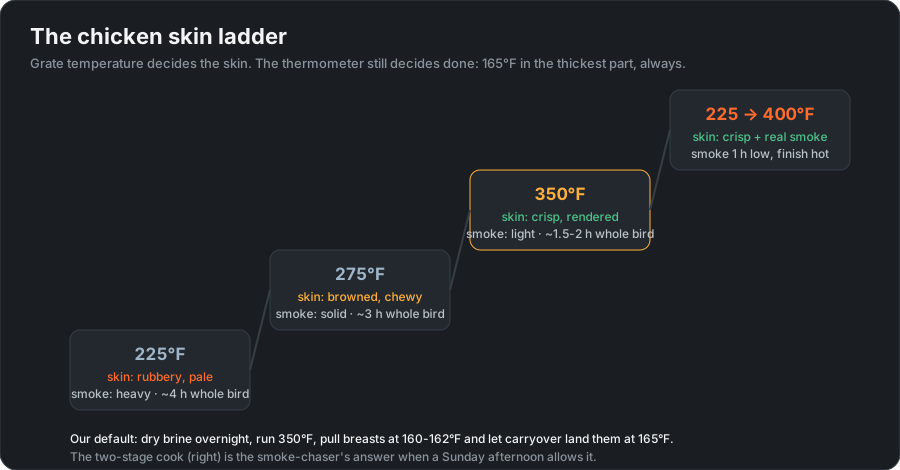
Neither, if you care about the skin. At 225 or 250°F the fat under chicken skin never renders, so the skin comes off soft and rubbery no matter how long you cook. I run chicken at 300 to 375°F, or smoke low for the first stretch and finish hot. You keep the smoke flavor and gain skin you can bite.
The 225°F habit comes from brisket and pork butt, where hours of low heat break down collagen. Chicken has almost no collagen to break down. It is lean, it cooks fast, and the only thing low-and-slow does for it is stretch the cook and steam the skin in its own moisture.
Between 225 and 250 the difference is minor. You shave maybe 30 to 45 minutes off a whole bird at 250, and the skin is slightly less flabby, but "slightly less flabby" is not a win. The real jump happens above 300°F, when skin fat starts rendering and the surface dries enough to crisp.
There is a second reason to run hotter that people rarely mention: chicken takes on smoke fast. A bird at 350°F on a pellet grill still picks up plenty of wood flavor in an hour, because pellet grills produce smoke across the whole cook, not just at startup. You are not trading flavor for texture. My default is 350°F flat out, and when I want a heavier smoke profile I run 250°F for the first 45 minutes, then crank to 400°F for the last 20 to finish the skin. Same logic I use when it is time to sear burgers on a pellet grill: the hot end of the dial is there for a reason.
How long does chicken take on a pellet grill?
Plan on 60 to 90 minutes for a whole 4 to 5 pound bird at 350°F, or 3.5 to 4 hours at 250°F. A spatchcocked bird finishes in 45 to 75 minutes at 375°F. Breasts need 30 to 45 minutes at 350°F, wings about 40 minutes at 400°F. Cook to 165°F internal, never to the clock.
Time charts are starting points, not finish lines. Bird size, how cold the meat went on, wind, and how often you open the lid all move the number. The chart below is what I log off my own cooks, and every row assumes the probe decides when it is done.
| Cut | Grill temp | Typical time | Pull at (internal) |
|---|---|---|---|
| Whole bird, 4 to 5 lb | 350°F | 60 to 90 min | 165°F breast |
| Whole bird, 4 to 5 lb | 250°F | 3.5 to 4 hr | 165°F breast |
| Spatchcocked bird, 4 to 5 lb | 375°F | 45 to 75 min | 165°F breast |
| Boneless breasts | 350°F | 30 to 45 min | 165°F |
| Bone-in thighs | 350°F | 45 to 60 min | 165°F, better at 175°F+ |
| Drumsticks | 350°F | 45 to 60 min | 165°F, better at 175°F+ |
| Wings | 400°F | 35 to 45 min | 165°F |
Two notes on that table. Thighs and drumsticks are safe at 165°F, but dark meat eats better pushed to 175 or even 185°F, when the connective tissue softens and the meat stops fighting the bone. Second, a leave-in probe beats guessing every single time. Chicken moves fast at 350°F, and fifteen distracted minutes is the gap between juicy and chalk.
Whole bird, spatchcock, or pieces?
Spatchcock wins for most cooks. Cutting out the backbone and flattening the bird evens out the thickness, so breast and thigh finish together in roughly two thirds the time, with all the skin facing the heat. Whole birds look better on the table. Pieces are the move when everyone wants something different.
A whole trussed chicken is a shape problem. The breast sits high and cooks fast, the thighs hide low and cook slow, and the skin down in the leg folds steams instead of crisping. Spatchcocking fixes the geometry in about three minutes with kitchen shears: cut out the backbone, press the bird flat, done. It is the single highest-return technique in this whole article, and the same trick saves Thanksgiving when you move up to a smoked turkey on a pellet grill.
| Format | Time at 350 to 375°F | Skin result | Cooks evenly? | Best for |
|---|---|---|---|---|
| Whole bird, trussed | 60 to 90 min | Good on top, soft in the folds | Breast finishes before thighs | Presentation, roast-chicken vibes |
| Spatchcocked | 45 to 75 min | Best of the three, all skin up | Yes, breast and thigh close together | Most cooks, most weeknights |
| Pieces | 30 to 60 min by cut | Very good, easy to flip | Each piece on its own timeline | Mixed crowds, meal prep, wings |
You do not need a big rig for any of this. A 4 to 5 pound spatchcocked bird fits on a mid-size pellet grill with room to spare, and chicken is exactly the cook I point beginners at because it is cheap, fast, and teaches temperature control in one evening. The grill I hand people for that first bird is the Z Grills ZPG-450A: 450 square inches, holds 350°F without drama, and costs less than the pellets some people burn in a year. Check the current price, and see how I put every grill through the same chicken test on the how we test page.
What internal temp is chicken done at?
165°F in the thickest part, per the USDA, and that applies to every kind of poultry: breasts, whole birds, legs, thighs, wings, and ground chicken. Probe the thickest part of the breast and the inner thigh without touching bone. Color is not doneness; smoked chicken can stay pink at 165°F.
This is the one number in barbecue that is not a matter of taste. The USDA safe temperature chart puts all poultry at a minimum of 165°F, which is 73.9°C, and there is no chef's-preference lower number the way there is with steak.
Where you probe matters as much as the number. On a whole or spatchcocked bird I check two spots: the thickest part of the breast, and the inner thigh near the joint. Both need to clear 165°F. Slide the probe in from the side of the breast toward the center rather than straight down, and keep the tip off the bone, which reads hotter than the meat around it.
One thing that throws people off with smoked chicken specifically: the meat near the bone can hold a pink tint even when fully cooked, and the smoke ring under the surface is pink by definition. Trust the thermometer, not your eyes. The temperature chart exists precisely because color has never been a reliable doneness signal in poultry. Pull at 165°F, rest ten minutes, and the juices settle instead of ending up on the cutting board.
Why is pellet grill chicken skin rubbery, and how do you fix it?
Rubbery skin means the fat under it never rendered and the surface never dried. Below about 300°F, both stall. Three fixes work: finish the cook at 400°F or higher, dry brine the bird uncovered in the fridge overnight, or dust the skin with a baking powder mix. Stack two and the skin turns crackly.
Chicken skin is a thin layer of fat and water wrapped in protein. Crisp skin needs that water gone and that fat rendered, and both of those are heat-and-dryness problems. A pellet grill at 250°F is a humid, moderate environment, which is why the low-smoked bird comes out looking lacquered and eating like a rubber glove. Sauce makes it worse, since a sweet glaze applied early just seals the moisture in and burns before the fat moves.
Here is what I have run on my own birds, and what each move actually buys you.
| Skin strategy | What you do | Outcome |
|---|---|---|
| High-heat finish | Smoke at 250°F, then 400°F+ for the last 15 to 20 min | Rendered, bite-through skin plus max smoke; my default |
| Hot the whole way | Run 350 to 375°F start to finish | Crisp skin, shortest cook, slightly lighter smoke |
| Dry brine overnight | Salt the bird, leave it uncovered in the fridge 12 to 24 hr | Dry surface that browns fast, seasoned meat throughout |
| Baking powder dust | Mix about 1 part baking powder to 3 parts salt, coat skin | Raises skin pH so it browns and blisters; big on wings |
| Sauce early (do not) | Glaze in the first half of the cook | Sugars scorch, skin steams; sauce only in the last 10 min |
The overnight dry brine is the sleeper here. It feels like planning ahead for no reason, until you see how fast a dry-skinned bird colors up at 375°F compared to one straight out of the wrapper. For wings I go straight to the baking powder mix at 400°F and skip the smoke stage entirely.
If you take one thing from this page: smoke is a flavor you add, but crisp is a temperature you hit. Get the bird flat, get the skin dry, get the grill above 300°F, and pull at 165°F. That is the whole game.
Should I brine chicken before smoking it on a pellet grill?
A dry brine, plain salt on the skin and an uncovered night in the fridge, is the easiest upgrade. It seasons the meat and dries the surface so the skin browns. Wet brines add moisture insurance for lean breasts but leave the skin waterlogged, so pat hard and air dry if you go that route.
What pellets are best for smoked chicken?
Milder woods suit poultry. Cherry gives great color, apple and pecan give a soft, sweet smoke, and a hickory blend works if you like a stronger edge. Straight mesquite tends to overpower a bird, especially on longer, lower cooks. Chicken picks up smoke quickly, so the blend matters less than the cook temp.
Can I still smoke chicken at 225°F if I want maximum smoke?
You can, and the meat will be fine, but plan the skin around it. Either finish the bird at 400°F or higher for the last 15 to 20 minutes to render the skin, or accept soft skin and pull it off before serving. At 225°F alone the skin will not crisp no matter how long you wait.
Why is my smoked chicken pink even at 165°F?
Smoke reacts with the meat and holds a pink tint near the surface and sometimes at the bone, especially in younger birds. That is chemistry, not undercooking. The USDA doneness standard is 165°F in the thickest part measured with a thermometer, and color is not a reliable indicator either direction.
Do I need to flip chicken on a pellet grill?
Whole and spatchcocked birds, no: pellet grills cook with circulating indirect heat, so leave them skin side up the whole time. Pieces benefit from one flip about two thirds through, mostly to even out color, and wings crisp best with a flip once the first side blisters.